



Life in Color
At the far end of Kiawah Island, Michael and Sandy Collins have created a home that blurs the line between architecture, landscape, and art. Inside, masterpieces by Jasper Johns, Helen Frankenthaler, and Damien Hirst share space with tidal light and the sound of marsh birds. Their life here is less about collecting than about living artfully—guided by curiosity, generosity, and serendipity.
Story by Hailey Wist | Photographs by Blake Shorter
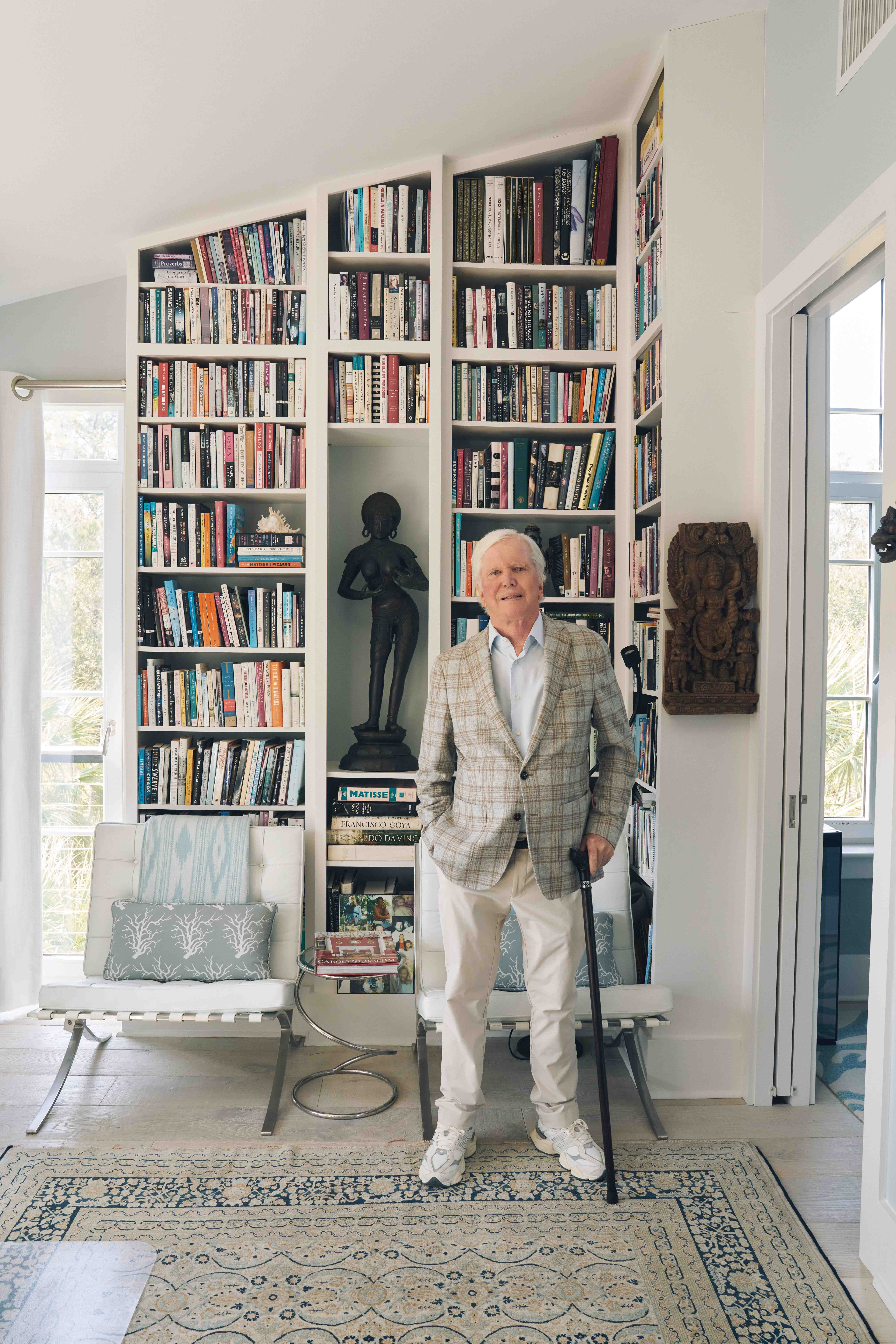
At the far end of Kiawah Island, where the forest bends toward the ocean and the tidal creeks run in silver ribbons to the horizon, Michael and Sandy Collins have built a home that feels less like a house than a sanctuary. It rises through the canopy, a tower of glass and clean lines, its rooms open to the sweep of marsh and the Atlantic beyond. Inside, the walls are alive with art—works by Jasper Johns and Damien Hirst, Robert Rauschenberg and Ed Ruscha—an extraordinary collection that speaks as much to a way of living as it does to any aesthetic taste. Being there is like entering a treehouse of ideas: expansive, elevated, filled with clarity.
The Collinses describe themselves as driven by an “insatiable intellectual curiosity,” and it is clear that this force has shaped both their lives and their collection. Michael’s journey began in the 1960s along La Cienega Boulevard in Los Angeles, when a cluster of small galleries defined the city’s emerging contemporary art scene. When he met Sandy, he found her a willing partner in this emerging dialogue with contemporary art.
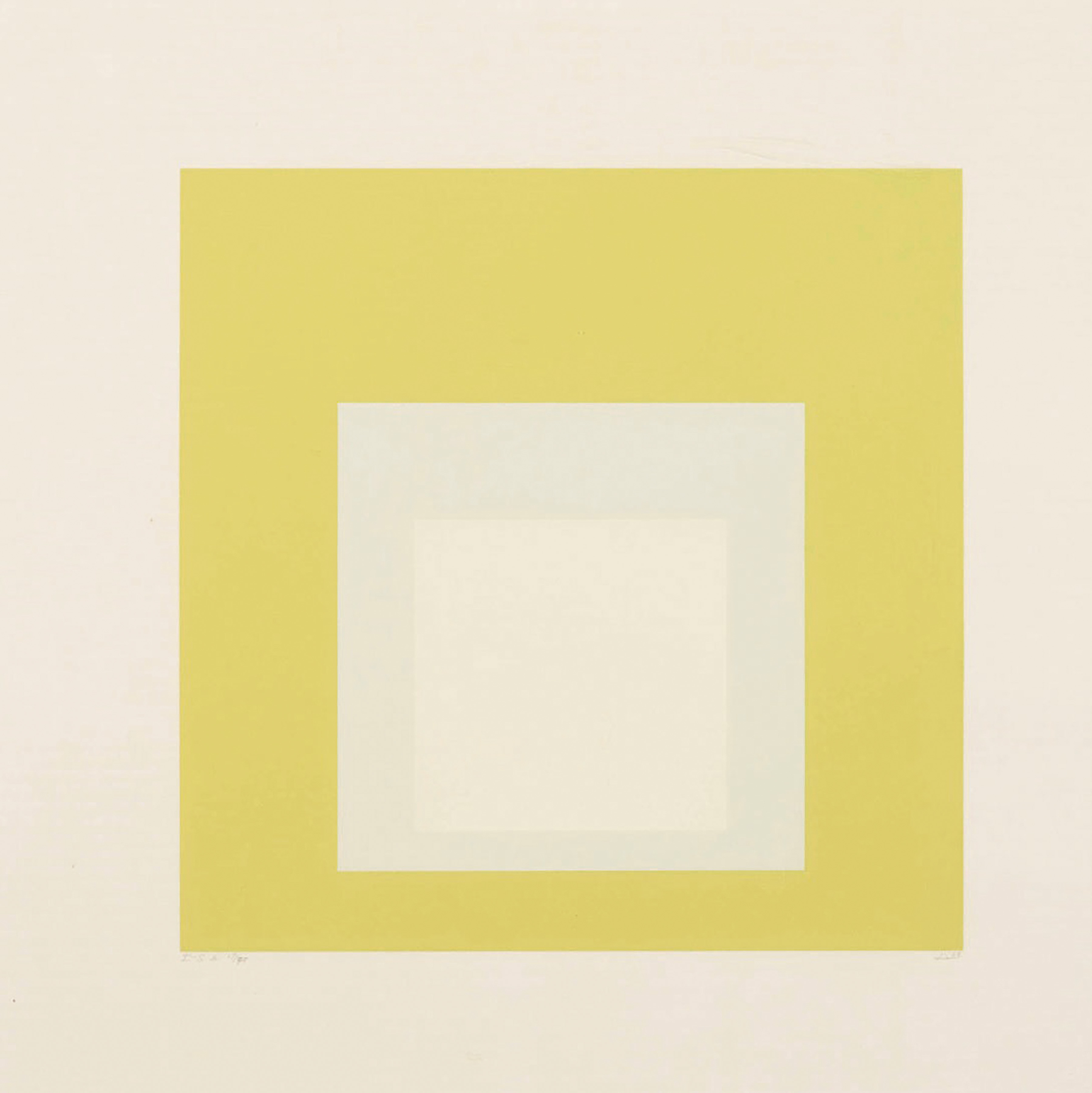
Homage to the Square by Josef Albers
Their approach has always been intuitive, guided less by strategy than by serendipity—the word they return to again and again, whether speaking of art, of travel, or of the friendships that have shaped their lives. “We’ve never worked with dealers or consultants,” Michael says. “We don’t have a plan. We do all our own selecting.”
That spirit of openness animates their collection, where time collapses and styles collide in unexpected harmony. Standing between a Jasper Johns from the 1960s and a Damien Hirst (his iconic butterfly) from the 2010s, Sandy gestures easily from one to the other: “From our point of view, it all fits together.” In the Collins’ bedroom, the view across the marsh is joined by Frankenthaler’s five piece What You Can Do with a Red Line, a Jim Dine robe, and a Marc Quinn eyeball, the effect both serene and electric. In the kitchen, a Sam Francis offers what Sandy calls “a strong cup of coffee,” a Jane Hammond collage glimmers above the dining table, and a Bert Stern portrait of Marilyn Monroe holds a place of honor. Outside on the lawn, a monumental Beverly Pepper sculpture—three thousand pounds of polished steel—gleams against the dense green of the marsh. Everywhere, the eye moves between landscape and artwork, the natural and the constructed, the timeless and the immediate.
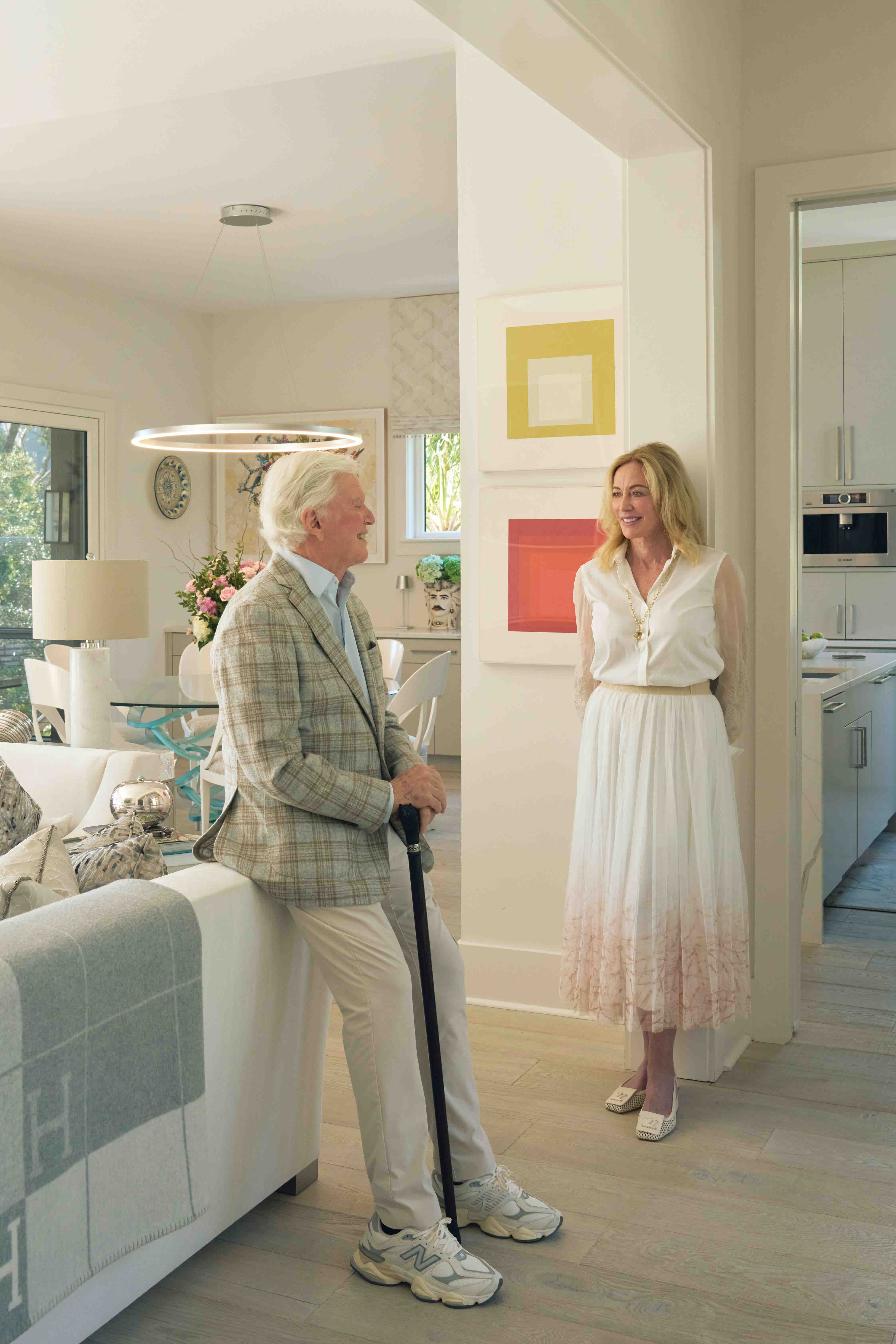 Over the years, the Collinses have lived with Jasper Johns’s Colored Numbers, an Andy Warhol print of Marilyn Monroe, and a range of works by artists they knew personally, like Ed Ruscha. One of Ruscha’s paintings of the Hollywood sign, made in the early 1970s from Pepto-Bismol and caviar, hangs intact in a guest bedroom thanks to careful preservation inside a sealed acrylic box. Yet they are not collectors in the conventional sense. They do not buy art as investments, nor do they sell when their tastes change. If a work no longer fits their home, it is given to family or museums. Nothing goes into storage. For them, the act of collecting is not about possession, but about living with the work—encountering it daily, letting it shape the texture of life.
Their collection is inseparable from their passion for travel and adventure. They have lived in Dallas, Coral Gables, Aspen, and briefly in Florence, where they moved with their children for a year, immersing themselves in language, food, and the Italian masters. It was then that they co-founded Friends of Florence with dear friend, Countess Simonetta Brandolini d’Adda. The nonprofit, now in its twenty-fifth year, allows donors to fund the restoration of specific works—an approach that creates a rare intimacy with the art itself. The Collinses themselves have funded the restoration of Michelangelo’s David, Botticelli’s Primavera, and Donatello’s Gates of Paradise. “We don’t feel like we have to own something for it to be personal,” Michael says. This is their way of extending their philosophy of collecting into the public sphere—supporting preservation not through ownership, but through stewardship.
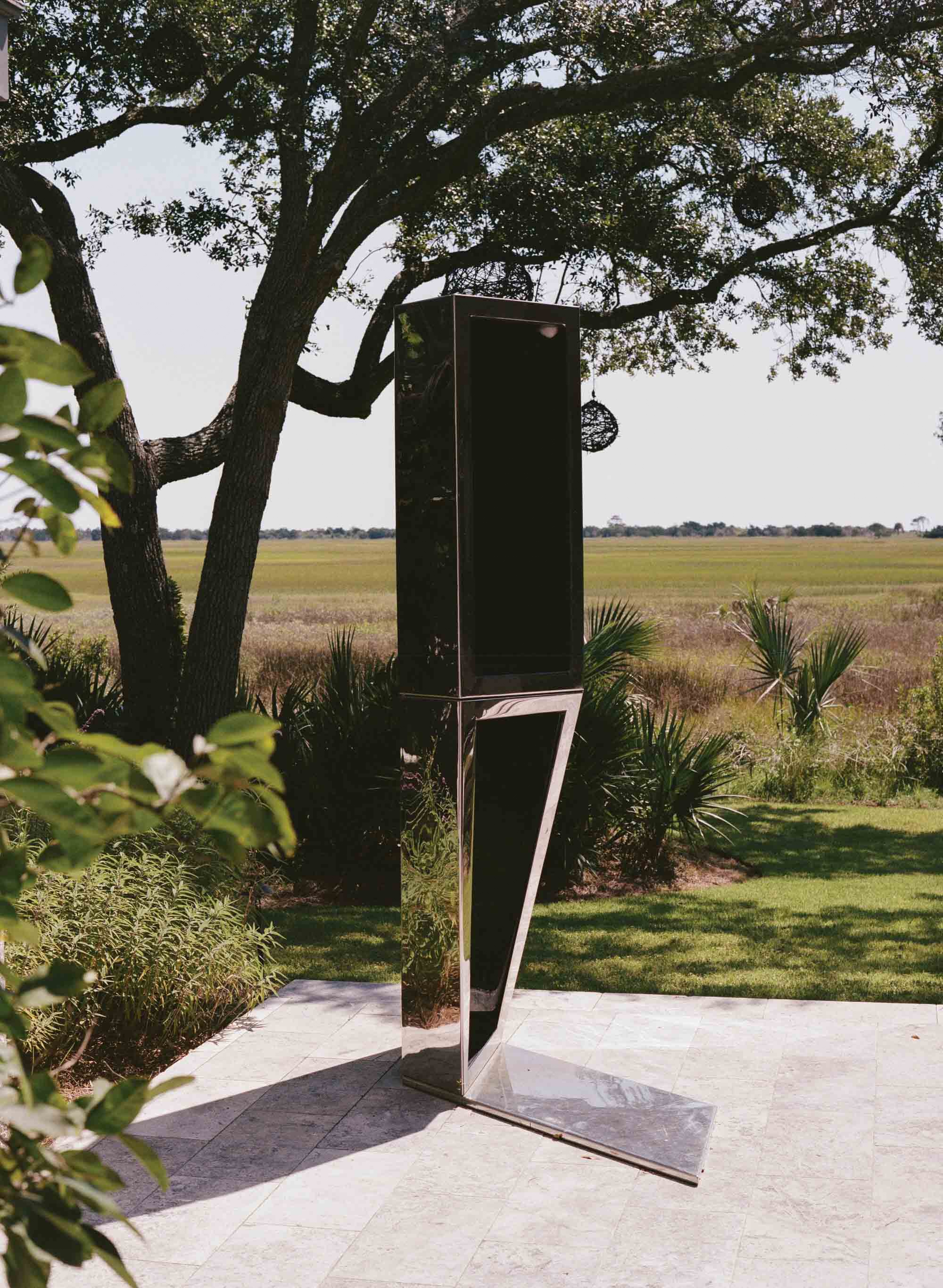
Polished Steel Sculpture by Beverly Pepper
This openness to connection has marked Michael’s broader commitments as well. He has served on the boards of The Smithsonian, the Dallas Museum of Art, and Miami’s Museum of Contemporary Art, lending his expertise in acquisitions and strategy. Through the Bohemian Club, he met filmmaker Ken Burns and in a conversation about dream projects discovered Burns’s long-held desire to create a documentary on Leonardo da Vinci. Recognizing the resonance with his work in Florence, Michael and Sandy provided seed funding. The film premiered on PBS in 2024, a testament to the same serendipity that has guided so many of his endeavors.
Adventure has been another thread running through their lives. Michael has floated the great rivers of six continents, trekked the Amazon, and climbed Kilimanjaro with his daughter. In recent years, Sandy has also summited Kilimanjaro and trekked the Dolomites, Mont Blanc, and the Rockies. Their home reflects these journeys as well: Burmese carvings, Mongolian urns, stirrups from Colombia—artifacts gathered not as trophies, but as reminders of lives lived in full embrace of the world’s variety. In Michael’s upstairs office, walls of books and shelves of objects speak to decades of restless curiosity. Outside, ibis settle into the marsh grasses, and Sandy laughs softly: “It is bird heaven here.”
In more recent years, Michael has turned to ancient Japanese art, collecting pieces from 800 to 1800 CE. For him, the connection to contemporary abstraction is direct. “One of the first times I went to Japan I saw these huge calligraphy pieces, six feet tall,” he recalls. “If you’ve ever looked at those, that’s the purest form of abstract paint.” Sandy is less enamored, relegating most of the Japanese works to the second floor, but together their tastes have largely merged. “We’ve been together thirty years,” Michael says. “It really has been a shared experience.”
The Collinses came to Kiawah knowing almost nothing about it. “After our first excursion under the canopy of ancient oaks and Spanish moss, we looked at each other and said, This is it!” remembers Michael. For him, it was the ocean. For Sandy, it was the seasons. The landscape felt instantly right. Michael lovingly refers to Kiawah as their “little corner of paradise.”
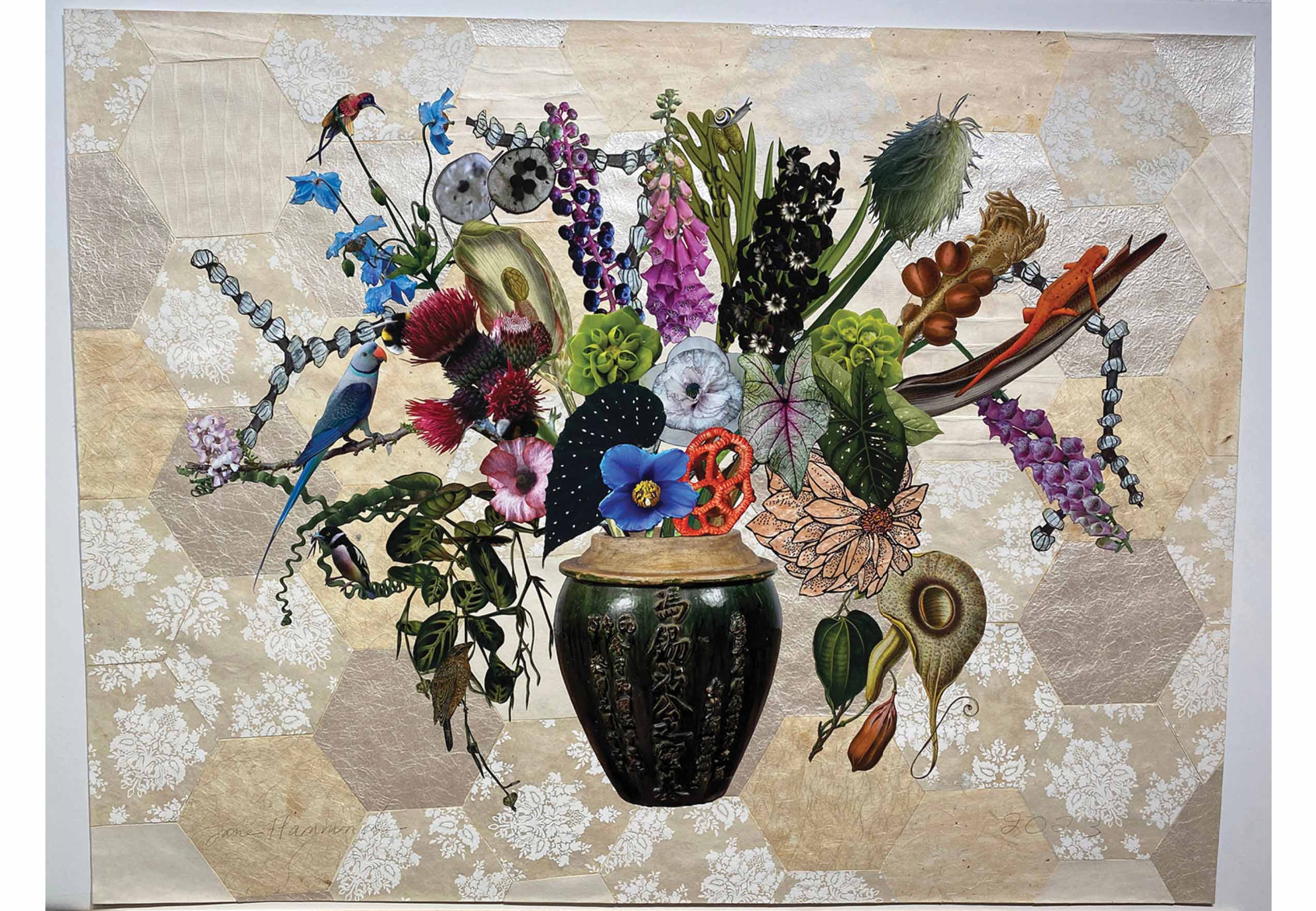
Mixed-media Collage by Jane Hammond
To stand in their home is to understand that what they have built is not a collection so much as a philosophy of life. It is visible in the Frankenthaler in the bedroom, the Pepper in the yard, the Ruscha sealed in acrylic; in the summers spent in Aspen and the winters spent by the ocean; in the long hours in Florence’s museums and the years lived between mountains and sea. It is a life defined by curiosity, by the willingness to be moved, by the pursuit of joy. For the Collinses, art is not an accessory or an asset but a way of being in the world, a reminder that beauty and serendipity are always within reach.